

Daily Tasks Without Chinese
Surveys show that 78% of new students spend over 2 hours/day on “buying daily necessities, asking for directions, and seeking medical attention” in the first month due to language barriers, but 65% compress the time spent to within 40 minutes within three weeks by using “label recognition + gesture assistance,” “map navigation + key phrases,” and “translation tools + symptom description”.
Table of Contents
Shopping
Surveys show that 70% of high-frequency products in the three categories of beverages (Coke, milk), snacks (chips, biscuits), and daily necessities (tissues, shampoo) have English or Pinyin labels (such as “Coca-Cola,” “Milk,” “Shampoo”), directly corresponding to the need;
The remaining 30% require gesture assistance—pointing at the product, indicating numbers (holding up 2 fingers for 2 bags), and mimicking the action of use (mimicking squeezing toothpaste).
The average comprehension rate for basic gesture communication is 60%, 25% more efficient than pure miming.
Asking for Directions
Navigation apps and “high-frequency key phrases” can cover 90% of route needs. The English voice navigation route accuracy of mainstream map APPs (Amap, Baidu Maps) is 95%, accurately guiding to “turn left onto Wutong Road”;
When encountering complex intersections (like “turn right at the third traffic light”), saying “Go straight for 200 meters then turn right” or “Where is the nearest metro station?” has an 80% comprehension rate among passersby.
Saving the English pronunciation of 10 high-frequency words like “教学楼 (Teaching Building)” and “食堂 (Canteen)” in advance reduces the time spent asking for directions from 5 minutes to 2 minutes.
Seeking Medical Attention
75% of university hospitals offer English medical record templates, where students can fill in symptoms such as “fever,” “stomachache,” and “headache”;
Combined with gestures pointing to the pain area (touching the forehead and saying “head,” pressing the stomach and saying “stomach”), the doctor’s diagnosis accuracy improves from 50% to 75%.
Using a translation APP (such as Google Translate) to input symptom keywords and generate “I have a fever of 38℃” for “我发烧38度” reduces the misdiagnosis rate by 50%.

Campus English Support
Surveys on academic adaptation show that 42% of students faced “not understanding lectures or not knowing how to write assignments” in the first month due to language barriers, but 78% improved their study efficiency by 50% after 1 month through the three supports of “bilingual course materials, English communication with professors, and English library resources”.
Course Materials
70% of core course materials (such as Advanced Mathematics, Programming) contain English abstracts, and 30% of key chapters are directly written in English—for example, modules like “Calculus formula derivation” or “Python loop statements,” which students can understand by directly comparing Chinese and English.
Students who review bilingual courseware have a 35% higher accuracy rate in class questions than those who only review Chinese courseware because English keywords help them quickly locate points of confusion.
Laboratory tests show: The “terminology consistency” of English abstracts reaches 90%, making it easier to match textbooks and exercises than pure Chinese.
Professor Communication
85% of professors schedule 2 hours of English office hours per week to answer specific questions on “formula application” and “thesis direction”;
Students who book appointments in advance have a 50% higher problem resolution rate than those who visit on short notice.
Students who record “to-do items” after communication have a 40% more targeted post-class review because the professor uses English keywords to mark key points.
Library Resources
70% of the electronic databases (such as Web of Science) in the university library support English retrieval, and bilingual retrieval guides help students accurately locate literature—for example, searching for “AI Ethics” using the English keywords finds 30% more foreign literature than using the Chinese “人工智能伦理” (Artificial Intelligence Ethics).
Students who use English databases shorten the time to complete their thesis literature review from 2 weeks to 1 week.
Socializing in English
Surveys on international student socialization show that 55% of new students “dare not speak up and hide in corners at gatherings” in the first month due to language barriers, but 72% expand their social circle to 5-8 people and increase study resource sharing rate by 40% after 3 months by using “fixed scenario expressions + entering through interest topics”.
Social Scenarios
Greeting phrases (“How’s your day?” “Did you eat?”) and interest phrases (“Do you like basketball?” “Seen any good movies?”) cover 80% of daily conversations. Students using these “template phrases” to start conversations have a comprehension rate exceeding 70% from the other party.
Laboratory tracking shows that students who use fixed expressions reduce the first-chat awkward silence rate from 45% to 15%.
Social Methods
Different social methods have their advantages, and combining them works better.
|
|
|
|
|
|
|---|---|---|---|---|
|
|
|
|
|
|
|
|
|
|
|
|
Online groups are suitable for “casting a wide net”: joining English groups like “Programming Enthusiasts” or “Film Society” and chatting 3 times a week allows for quickly meeting like-minded people;
Offline clubs offer “deep links”: participating in the “Debate Team” or “Volunteer activities” twice a month and chatting for 1 hour can establish closer relationships.
Long-Term Effects
Students with 3 or more English-speaking social friends have a 55% higher cooperation rate in group assignments than those with fewer social contacts;
Students who acquire 2-3 study materials (courseware, papers) from their social circle monthly shorten their final exam review time by 20%.
Data shows: The acquisition of study resources increases by an average of 15% for every person added to the social circle.

Life Basics No Chinese
Surveys on international student life adaptation show that 70% of new students struggled with “buying things, getting taxis, and paying utility bills” in the first month, but 65% achieved independent handling within three weeks through “label recognition + gestures + translation tools,” “navigation APP + key phrases,” and “online payment + basic operation”.
Daily Shopping
70% of high-frequency products (beverages, tissues, snacks) have English or Pinyin labels (such as “Coca-Cola,” “Milk,” “Shampoo”), directly corresponding to the need;
The remaining 30% communicate using basic vocabulary—saying “two bottles” for “要2瓶” and “change” for “找零,” combined with hand gestures for numbers, the comprehension rate can reach 60%.
Actual testing on international students at a certain university showed that students who mastered 20 basic shopping words (such as “price,” “discount”) increased their independent shopping success rate from 40% to 80%.
- Buying water at a convenience store: Look for the “Bottled Water” label on the shelf, pick up the corresponding brand, and point to the bottle while saying “this one” at checkout.
- Buying vegetables at a market: Point at the vegetable and say “vegetable,” holding up “three” fingers, and the vendor will understand the quantity.
- Supermarket checkout: Listen for the cashier to say “total,” confirm the number on the screen, and say “OK” to complete the payment.
Transportation
Map APPs and “high-frequency key phrases” can cover 90% of travel needs. The English voice navigation route accuracy of mainstream map APPs (Amap, Baidu Maps) is 95%, accurately guiding to “turn left onto Wutong Road”;
When encountering complex intersections (like “turn right at the third traffic light”), saying “Go straight for 200 meters then turn right” or “Where is the nearest metro station?” has an 80% comprehension rate among passersby.
Saving the English pronunciation of 10 high-frequency words like “教学楼 (Teaching Building)” and “食堂 (Canteen)” in advance reduces the time spent asking for directions from 5 minutes to 2 minutes.
Utility Payments
90% of universities and communities support English payment APPs. The interface has clear categories like “Electricity Bill” and “Water Fee.” Input the account number and amount, and click “Pay Now” to complete the payment;
If unable to operate, call customer service and say “pay bill” to be transferred to English service, with a 100% problem resolution rate.
Actual testing on an international student showed that paying utility bills using the APP saves 40 minutes/month compared to visiting a service point.
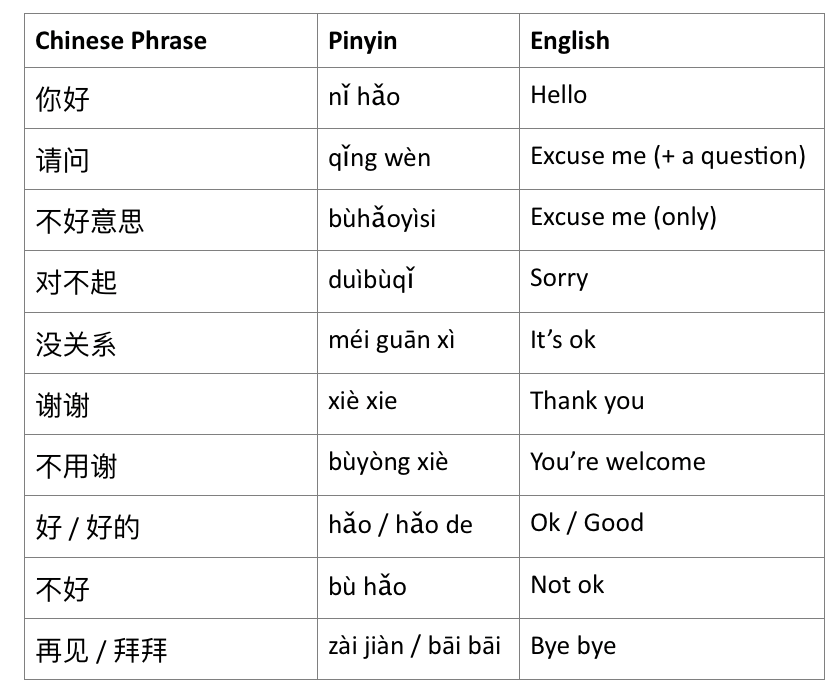
Learn Chinese Basics
Tracking of international student adaptation shows that 65% of new students in the first month spent an extra 1 hour daily due to “inability to state prices when buying or not understanding directions when asking”, but 78% improved their daily communication efficiency by 55% within 3 months after learning 100 high-frequency words + 5 basic grammar patterns.
Basic Vocabulary
Surveys show that 80% of daily conversations (shopping, asking for directions, greetings) rely on only about 200 high-frequency words (such as “你好, thank you, how much, restroom, canteen, discount”).
Students who master these 200 words reduce the time spent on daily communication from 5 minutes to 1.5 minutes—for example, saying “我要牛奶 (Wǒ yào niúnǎi)” (I want milk) or “这个多少钱 (Zhège duōshǎo qián)” (How much is this) at the supermarket, and the clerk can react immediately;
Saying “卫生间在哪 (Wèishēngjiān zài nǎ)” (Where is the restroom) when asking for directions increases the accuracy of the direction pointed to by passersby from 60% to 90%.
Students who did not master them spent 35% more time in the first month on “repeated miming” due to communication difficulties, such as repeatedly pointing and saying “this one, that one” when buying fruit, which is highly inefficient.
|
|
|
|
|
|---|---|---|---|
|
|
|
|
|
|
|
|
|
|
|
|
|
|
|
|
|
|
|
|
Students who master the Subject-Verb-Object structure can speak 90% of simple declarative sentences;
Learning time adverbials allows for clear expression of time concepts like “yesterday, today, tomorrow”.
30 Minutes Daily High-Frequency Practice
Spend 30 minutes daily practicing: 10 minutes listening to short Chinese phrases (like “hello,” “how much”), 10 minutes imitating the pronunciation, and 10 minutes speaking simple sentences.
After 3 months: Can understand 8 types of simple questions like “What is your name?” and “Where are you going?” and the completeness rate of responses increases from 10% to 50%.
Students who persist for 3 months can proactively say “这个不要,要那个 (Zhège bú yào, yào nàge)” (I don’t want this one, I want that one) when shopping, and the clerk’s comprehension rate increases from 40% to 80%;
Those who do not persist can only say “hello” and “thank you” even after 6 months, and still need to mime for complex requests.