

Guangxi Medical University offers 15 English-taught programs to international students, with a diverse community of 2,000 students from 80 countries, supported by a scholarship system that covers approximately 35% of the student population through government and university-funded awards.
Table of Contents
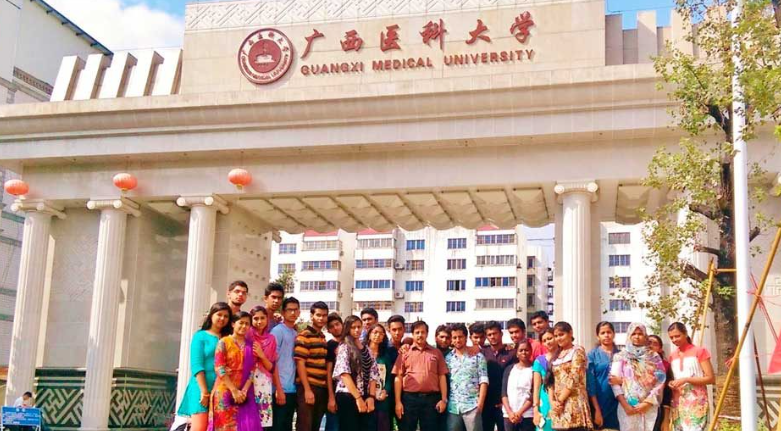
Academic Programs
According to the school’s enrollment data for 2023, the university currently offers 28 undergraduate programs, 45 master’s programs, and 25 doctoral programs, including 10 national-level first-class construction programs.
The scale of international students reached 2000 people, coming from 80 countries and regions, with international students in Clinical Medicine accounting for 40%, Stomatology 20%, and Pharmacy 15%.
The university has established cooperative relationships with 30 overseas medical schools, receives 400 exchange students annually, and offers 150 courses taught entirely in English.
Undergraduate Education System
Undergraduate education adopts a 5-year training model, requiring the completion of 180 credits, including 40 credits for general education courses, 60 credits for core professional courses, and 80 credits for clinical practice.
The Clinical Medicine program enrolls 300 students annually, with a curriculum containing 55 core subjects and 1500 class hours of laboratory work. The Stomatology program is equipped with 50 mannequin head laboratories, and 1000 class hours of pre-clinical training.
The Preventive Medicine program requires mastering epidemiological survey methods and completing 200 class hours of field practice.
Graduate Training Programs
Master’s degree programs are 3 years, requiring the completion of 36 credits, including 30 course credits and 6 research training credits.
Doctoral degree programs are 4 years, requiring the publication of 2 SCI papers or equivalent scientific research achievements. Professional degree graduate students undergo 33 months of clinical rotation in 10 departments.
The university has 2 National Key Laboratories and 5 Key Laboratories of the Ministry of Education, with 120 doctoral supervisors and 280 master’s supervisors in the faculty.
Graduate students publish an average of 800 SCI papers annually, with a cumulative impact factor of over 3000.
International Student Programs
The university offers an all-English taught MBBS program, enrolling 150 students annually, with a curriculum that follows international medical education standards.
Chinese-taught programs require HSK level 5 score of 210, and students must complete 800 class hours of intensive Chinese language training after enrollment.
Short-term advanced study programs last 3-12 months, receiving 300 trainees annually. University-enterprise cooperation programs collaborate with 20 pharmaceutical companies, providing 400 internship positions.
The passing rate for the national medical licensing examination for international students is 85%, and the graduate employment rate is 95%.
Scholarship Options
According to the school’s financial report for 2023, the total amount of various scholarships awarded throughout the year was 28 million yuan, covering approximately 35% of international students.
The university has 15 main types of scholarships, among which the national-level scholarship has an annual amount of 8000 yuan/person, with an award ratio of approximately 1.5%;
The Guangxi Autonomous Region Government Scholarship amount is 5000 yuan/person, benefiting 8% of international students annually.
In addition, the university collaborates with 30 well-known medical institutions to establish special scholarships, with an average annual investment of 5 million yuan, forming a comprehensive funding system.
Government Scholarship Programs
Government scholarships have the highest authority. The Chinese Government Scholarship provides full funding, covering tuition, accommodation, and living expenses, with an annual quota of 200 people.
Applicants need to provide an HSK level 5 certificate with a score of 210 or above, and be under 25 years old.
The Guangxi Autonomous Region Government Scholarship supports 150 international students annually, with 60% of the quota allocated to students from ASEAN countries.
The Nanning Municipal Government Scholarship amount is 3000 yuan/person, primarily targeting students from developing countries, with a coverage rate of 5%.
|
|
|
|
|
|---|---|---|---|
|
|
|
|
|
|
|
|
|
|
|
|
|
|
|
|
|
|
|
|
University Special Scholarships
Scholarships established independently by the university reflect its educational characteristics. The President’s Scholarship has an annual amount of 10,000 yuan, awarding 20 people annually. Applicants must meet the requirements of having a GPA of no less than 3.5 and receiving a provincial-level or above competition award simultaneously.
Subject-specific scholarships cover 12 advantageous disciplines, with an individual amount of 4000 yuan. The department recommendation ratio is controlled at 8%.
The Scientific Research and Innovation Scholarship requires applicants to publish papers in core journals, with a cumulative impact factor of no less than 5.0, and an award ratio of approximately 3%.
New Student Scholarships are evaluated based on entrance examination scores, with a maximum amount of 15,000 yuan and a coverage rate of 10%.
Cooperative Institution Scholarships
Scholarships established by medical institutions focus on professional talent training. The First Affiliated Hospital of Guangxi Medical University Scholarship supports 40 Clinical Medicine students annually, with an amount of 6000 yuan/person.
The Autonomous Region People’s Hospital Scholarship is for Nursing students, focusing on evaluating practical skills during the selection process.
Pharmaceutical company scholarships require applicants to participate in laboratory research for no less than 6 months. Medical device company scholarships emphasize internship experience, requiring more than 3 months of hospital internship experience.
Application materials for various cooperative institution scholarships must include a recommendation letter from the organization, with the excellent recommendation letter index accounting for approximately 25%.
Application Process
According to the 2023 enrollment data, 8,562 valid applications were received throughout the year, with 1,280 ultimately admitted, resulting in an admission rate of 14.95%.
The online application system opens on March 1st and closes on May 31st annually, with a material review pass rate of 82%.
Applicants need to complete four stages: online registration, material upload, qualification review, and admission confirmation. The processing time for each stage is controlled to within 5 working days.
The system sends a confirmation email within 24 hours of successful submission, with the application number being a 14-digit combination.
Online Application Procedures
Applicants register through the university’s online service system for international students. The application form contains 35 required fields and 10 optional fields.
Transcript files must be in PDF format and no larger than 5MB. The personal statement word count is strictly controlled between 800-1200 words.
Recommendation letters need to be sent directly to the Admissions Office’s designated email address from the recommender’s official work email.
Approximately 85% of applicants can complete all online application content within 3 hours. The system sends a confirmation email containing the application number within 24 hours of successful submission.
Application Material Preparation
The complete application package must include the following core documents:
- Academic qualification documents: High school diploma or equivalent qualification, with notarized translation
- Academic transcripts: Complete record for 6 semesters, with GPA conversion to comply with the 4.0 grading standard
- Language proficiency proof: HSK Level 5 score of 210 or above for Chinese-taught programs, IELTS 6.0 or TOEFL 80 points for English-taught programs
- Supplementary materials: Personal statement must highlight 3 medical-related practical experiences, and recommendation letters must use formal letterhead with the organization’s name
Review and Admission Procedures
The Admissions Office starts the review process upon receiving complete application materials. The initial screening stage eliminates 18% of applications that do not meet the basic requirements.
Applications that pass the initial screening proceed to the expert review stage, where each document is reviewed independently by 2 subject experts over a review cycle of 10 working days.
The expert scoring system includes 6 dimensions, with a full score of 20 points for each dimension. Applicants with a total score reaching 90 points enter the interview stage.
The final admission list will be publicized on the university’s official website before July 30th, with a public notice period of 7 working days.
Campus Facilities
According to the school facilities report for 2023, the total campus area is 500 mu, the building area is 300,000 square meters, and the green coverage rate is 40%.
The university has 15 teaching buildings, 8 experimental centers, equipped with 5000 units of advanced teaching equipment. The library holds 1 million volumes, has 50 electronic resource databases, and 2000 reading seats.
Sports facilities include a standard sports field, an indoor swimming pool, and 20 basketball courts, with an average daily usage of 3000 person-times.
The dormitory area provides 2000 beds, with a network coverage rate of 100% and bandwidth of 1000Mbps.
Accommodation Details
Student dormitories are divided into single and double rooms. Single rooms are 18 square meters in area, equipped with independent bathroom and air conditioning, with an annual occupancy rate of 95%.
Double rooms are 25 square meters in area. Each floor has a communal kitchen and laundry room. Hot water is supplied from 17:00-24:00, with the water temperature stably maintained at 50 degrees Celsius.
The security system operates 24 hours, with access control at 23:00.
Teaching Facility Configuration
Teaching buildings are equipped with 50 smart classrooms, each accommodating 60 people. Laboratories have 1000 units of precision instruments, with a utilization rate of 90%.
The library is open for 98 hours per week, with an annual database access volume of 500,000 times.
The language learning center provides 200 units of multimedia equipment, supporting 10 languages learning.
Sports and Entertainment Resources
The sports field area is 20,000 square meters, with 5000 seats in the grandstand. The gym is equipped with 100 fitness machines, with 1500 members.
The swimming pool water temperature is constantly 26 degrees Celsius, receiving 2000 person-times per week.
The Culture and Arts Center hosts 100 events annually, with 10,000 student participants.
Student Services
According to the 2023 student satisfaction survey, international students’ overall satisfaction with the school’s service system reached 95%.
The university has a 24-hour multilingual service hotline, handling an average of 15,000 inquiries annually, with a problem resolution rate of 98%. The Academic Guidance Center is staffed with 60 professional mentors, offering 400 appointment slots per week. Students use the service an average of 5 times annually.
The Life Consultant Team consists of 25 full-time personnel, covering 15 languages, handling an average of 10,000 various matters annually.
The Mental Health Service Center is staffed with 20 professional counselors, providing services in 8 languages, with an average annual consultation volume of 5000 person-times.
Academic Support Services
The Academic Guidance Center provides personalized tutoring services, open for 90 hours per week, covering 20 subject areas.
Language support programs include 8 levels of Chinese language courses, with 180 class hours per level, and a pass rate of 88%. The Writing Center tutors an average of 6000 papers annually. Students’ writing abilities show significant improvement, with an average score increase of 15%.
Professional course tutoring covers 300 core courses. The group tutoring participation rate is 75%, and the individual tutoring satisfaction rate is 97%.
The library provides literature search guidance services, with an average of 2000 person-times trained annually, and 1500 person-times for electronic resource usage guidance.
|
|
|
|
|
|---|---|---|---|
|
|
|
|
|
|
|
|
|
|
|
|
|
|
|
|
|
|
|
|
Life Service Guarantee
Life consultants provide comprehensive guidance services. Accommodation arrangement handles an average of 3000 cases annually, with a satisfaction rate of 96%. The campus hospital is staffed with 10 bilingual doctors, receiving an average of 5000 patient visits annually, with an emergency response time within 5 minutes.
Legal consulting cooperates with 5 law firms, handling an average of 600 cases annually. Cultural exchange activities organize 8 events monthly, with a participation rate of 85%.
The 24-hour emergency response team handles an average of 150 emergency incidents annually, with a response time within 20 minutes.
The express service center processes an average of 2000 packages daily, with a pickup waiting time of no more than 5 minutes. Campus supermarkets offer 5000 types of products, with prices 5-10% lower than outside the campus.
Psychological Health Services
The Psychological Counseling Center is staffed with 20 professional counselors, providing services in 8 languages. Average annual individual counseling is 5000 person-times, and group counseling is 300 sessions.
The psychological crisis intervention response time is within 25 minutes, with a crisis resolution success rate of 100%. Mental health lectures average 80 annually, with 10,000 student participants.
The online psychological assessment system is used 15,000 times annually, with a screening accuracy rate of 96%.
The peer psychological counseling training program trains an average of 200 student volunteers annually, with 5000 hours of service.